
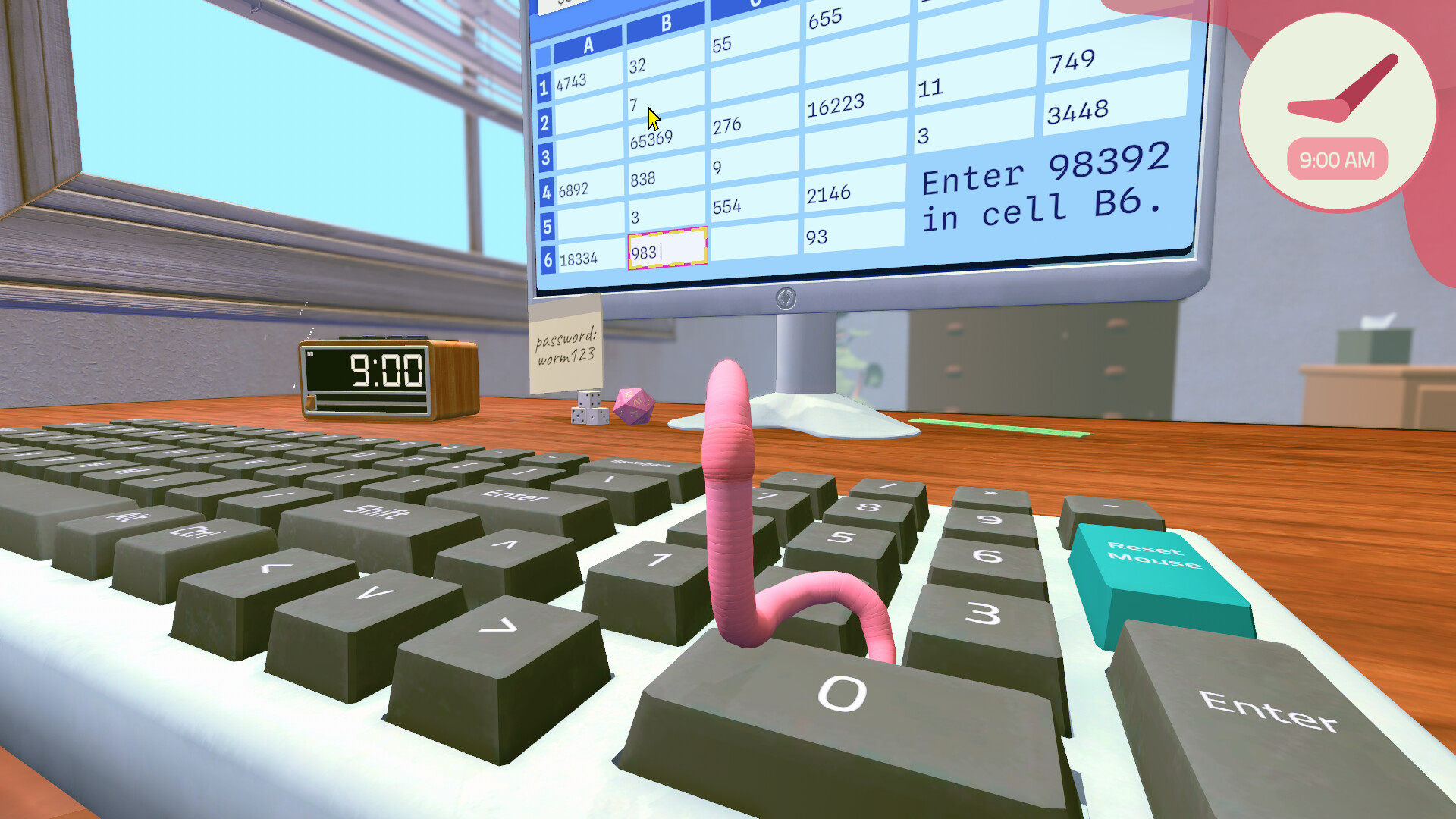
Worming from Home succeeds not because it's a novelty ("what if a worm had a job"), but because it's one of the sharpest, most self-aware corporate satires in indie games right now — a job sim that understands the soul-crushing rhythm of remote work well enough to turn it into slapstick.
What if the only thing standing between you and a promotion was a boss who saw you, correctly, as prey?
That's not a metaphor. In Worming from Home, your manager is framed — quite literally — as a predator, and you, the junior financial analyst, are a worm. A real, ragdolling, boneless worm, flopping across a keyboard in a desperate attempt to look like you're contributing to quarterly earnings. It's a stupid premise. It should not work. It works.
Job sims aren't new, and "cute animal does mundane human task" has been a reliable indie subgenre since at least Goat Simulator taught developers that physics comedy sells. But Worming from Home is landing at a moment when remote work satire has real cultural teeth — everyone who has ever jiggled a mouse to stay "active" on Slack will recognize exactly what this game is making fun of. The developer has also been unusually transparent about building the game in public, rolling out major features — a platforming mode, a "chill mode" — in direct response to community feedback ahead of its September 4th release. That kind of iterative, player-shaped development has generated real anticipation, and the drip-feed of increasingly unhinged trailers has done a lot of the marketing legwork for free.
The game's greatest strength is that it never treats its central joke as a one-liner. The "you are a worm" concept is baked into the actual moment-to-moment mechanics through what the developer calls "state of the art ragdoll physics" — every task, from answering messages to filling out spreadsheets, becomes an exercise in throwing your spineless body at a keyboard and hoping for the best. Bashing your head against the keys to convince your boss you're working isn't just a funny mental image; it's the literal control scheme. The comedy isn't sitting on top of the gameplay, it is the gameplay, and that's a much harder trick to pull off than it looks.
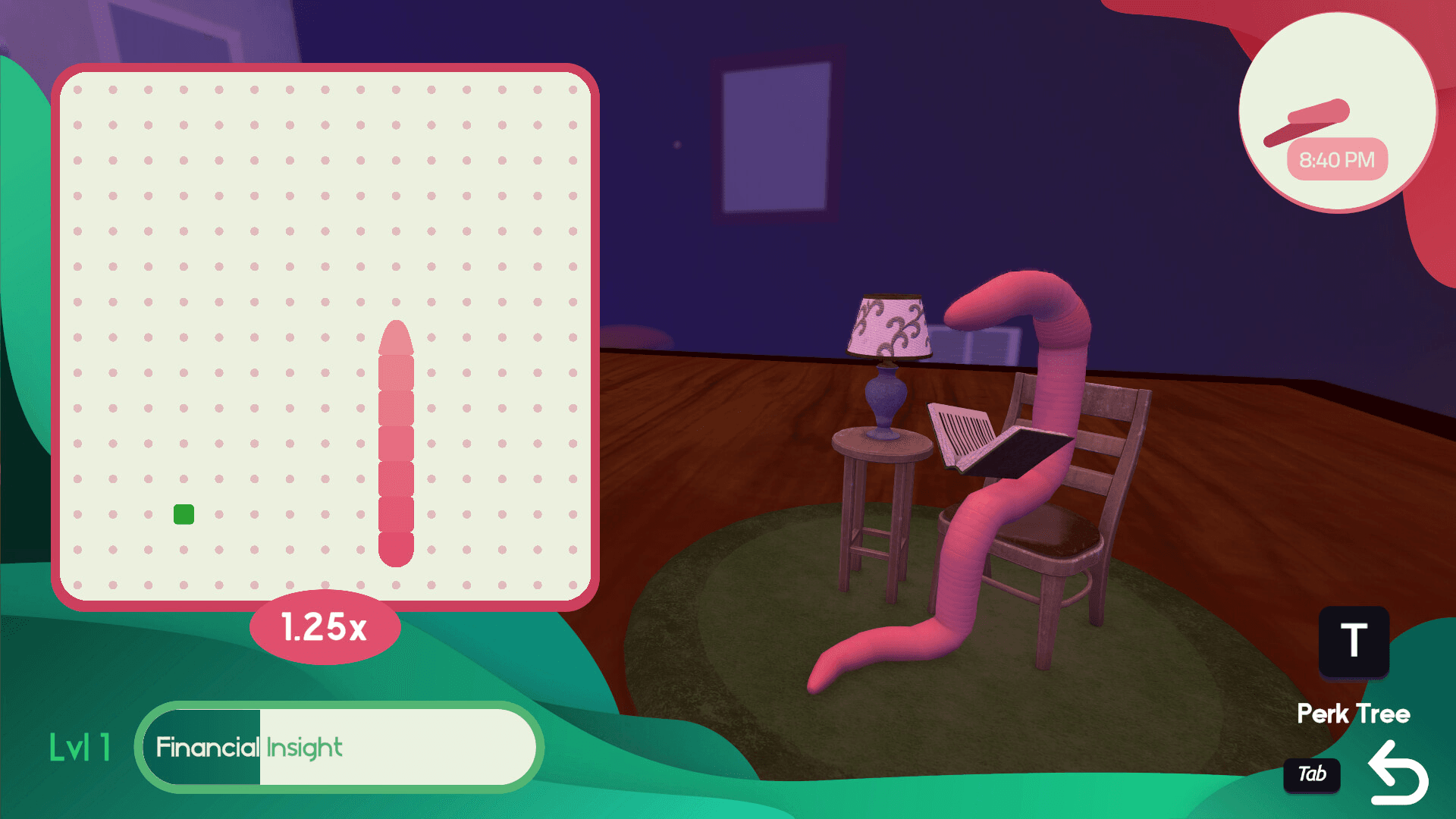
Underneath the flopping, there's a surprisingly complete progression loop. You're not just performing worm-shaped chaos for its own sake — you're climbing a corporate ladder, investing in the stock market (insider trading included, because why not), upgrading your desk setup, and spending your off-hours getting swole at the gym, reading self-help books, shopping for trinkets, or flirting with coworkers. It's a loop built on the same psychological hooks that make real job sims and idle games addictive: incremental power, cosmetic reward (hats — so many hats), and a light narrative carrot in the form of that promotion you're chasing. The game is smart enough to know that "buy a bunch of hats, you deserve a treat" is, itself, a joke about how we cope with soulless jobs — and it lets you actually do it.
What gives Worming from Home its distinct identity, though, is how visibly it's being shaped by the people playing it. When players said the game needed more actual platforming, the developer didn't bolt on a generic obstacle course — they built a "worm hole" portal that sucks you into a glowing, minimalist shadow-realm gauntlet, complete with a genuinely difficult normal mode and an even meaner hard mode that hides your jump-charge timer and sends you back to start on any failure. That's a real design swing, closer to a rage-game challenge run than a job sim side activity. And when other players said the deadline pressure was too stressful, the developer added a "chill mode" where missed deadlines simply reschedule instead of failing outright, rather than removing stakes altogether. Offering both a punishing precision-platformer and a stress-free chill mode in the same game is an unusual design philosophy — most games pick a lane. Worming from Home is betting it can be a hangout sim and a hardcore platformer depending on which portal you walk into, and that duality is shaping up to be its real identity, more than the worm gimmick itself.
The honest weakness here is focus. A game that wants to be a chill hangout sim, a satirical office comedy, an idle-upgrade grind, and a punishing rage-platformer is juggling a lot of tonal plates, and based on what's been shown, it isn't yet clear how gracefully those modes sit next to each other rather than existing as separate, walled-off minigames. Players who want a tightly focused experience — just the satire, or just the platforming — may find the breadth diluting rather than enriching. And because so much of what's public right now is dev-update footage rather than a full release build, there's real uncertainty about how deep the "financial analyst" simulation goes once the novelty of ragdoll comedy wears off. If the core loop can't sustain interest without the jokes carrying it, the chill-mode crowd in particular may find themselves bored once the hats run out.
That predator-and-prey framing from the trailers isn't just a punchline — it's the whole thesis of the game in miniature. Your manager isn't evil, just "results-driven," which is somehow scarier. And your only weapon against that ferocious-but-beatable beast is being a worm who refuses to take any of it seriously. That's the joke, and it's also, weirdly, the coping mechanism the game is offering its players.
Worming from Home is shaping up to be one of the more confident and formally inventive job sims in recent memory — a game that's willing to let a dumb premise carry real design ambition, and one that's been unusually responsive to the community shaping it in the run-up to launch. If you've ever wanted to answer a Slack message by faceplanting into your keyboard, you should absolutely be watching for its September 4th release. Just go in expecting a game figuring out how to be several different games at once — flopping its way toward whatever it wants to be, much like its protagonist.