
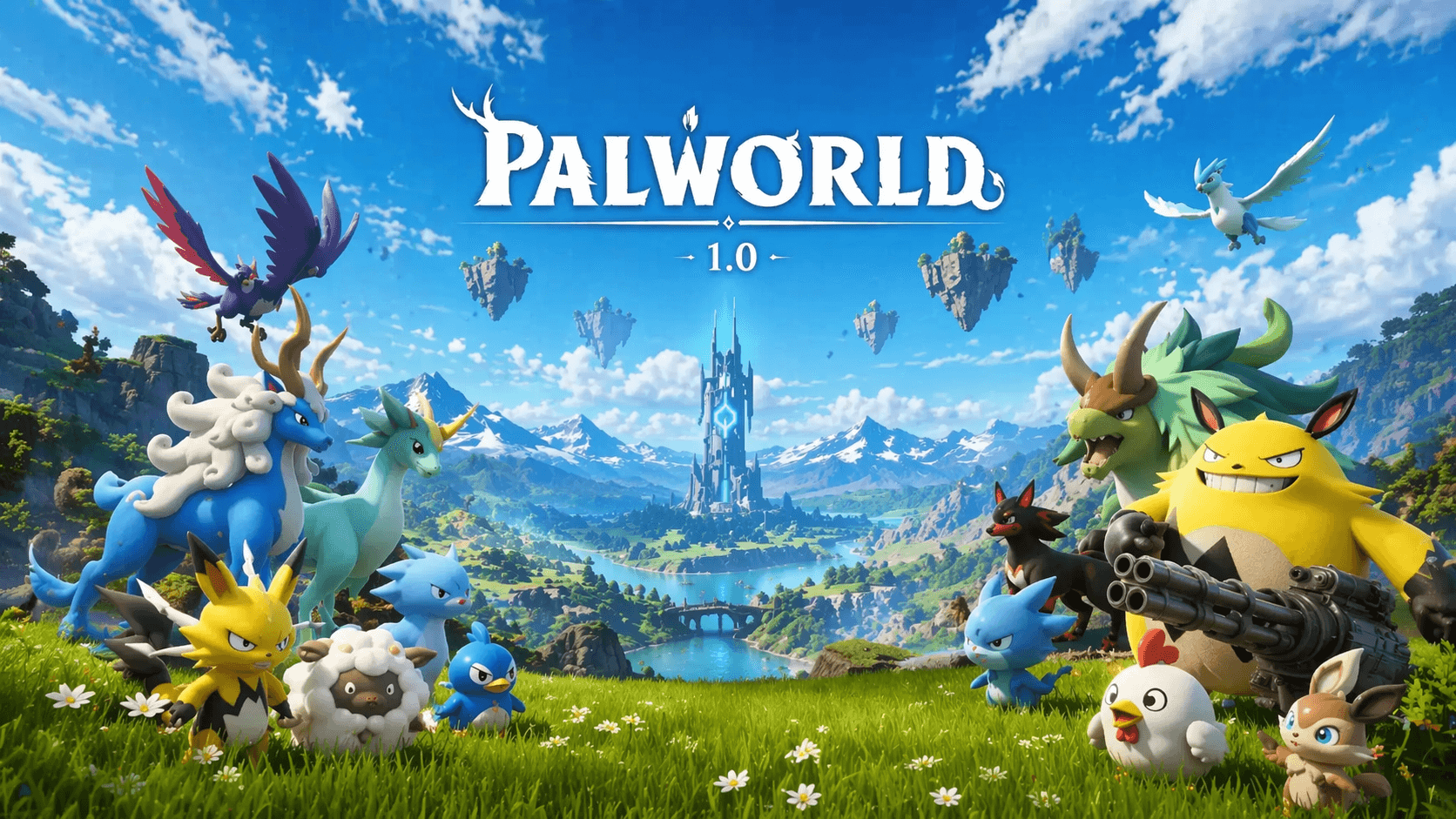
When Palworld launched in Early Access, almost nobody was talking about its gameplay. They were talking about the joke.
"Pokémon with guns."
It was the kind of headline that guaranteed attention. Millions of players rushed in, social media filled with clips of assault-rifle-wielding creatures, and critics were quick to predict that the game would disappear as soon as the novelty wore off.
For a while, they had a point. The concept was carrying the conversation.
Two years later, version 1.0 changes that conversation completely. Today, the most interesting thing about Palworld isn't what inspired it. It's what it eventually became.
The guns got people through the front door, but they were never the reason players stayed. If Palworld had relied solely on its controversial premise, it would've followed the same trajectory as countless viral survival games—an explosive launch followed by a slow fade into irrelevance.
Instead, players kept coming back, and that raises a more interesting question: why?
The answer isn't difficult to find once you've spent enough time with the game. Beneath the internet meme lies an exceptionally well-designed gameplay loop. Every expedition rewards your curiosity with something meaningful—a stronger Pal, a rare resource, a new blueprint, a better weapon, or another production line waiting to be optimized. Every reward naturally creates another objective before you've even finished the last one.
That's not an accident.
It's smart game design.
Most people still describe Palworld as a creature-collecting game, but that feels increasingly incomplete. Collecting Pals is only the first step in a much larger system. A Pal isn't just another creature to add to your collection. It's a miner, a farmer, a transporter, a power source, a combat companion, and eventually an essential part of your entire production chain.
Every new Pal doesn't simply make you stronger.
It makes your world more efficient.
That distinction changes how progression feels. Instead of leveling up a single character, you're gradually building an ecosystem where every system supports another. Exploration leads to new companions. Those companions improve automation. Better automation unlocks faster progression, which in turn encourages even more exploration.
The result is a gameplay loop that's remarkably difficult to walk away from.
Explore. Capture. Automate. Expand. Repeat.
By the time you've completed one goal, the game has already given you three more.
Version 1.0 understands something many Early Access games never quite achieve. More content alone isn't enough.
Most games leave Early Access by adding new weapons, larger maps, and stronger enemies. Palworld certainly does all of that, but what impressed me wasn't the quantity of new content. It was the sense of direction behind it.
Everything now feels connected. Exploration fuels automation. Automation accelerates progression. Progression opens new parts of the world. Rather than feeling like a collection of popular survival mechanics stitched together, version 1.0 finally gives every system a clear purpose. For the first time, Palworld feels like a game that knows exactly what it wants to be.
That doesn't mean it's flawless.
The story remains functional rather than memorable, existing mainly to push players toward the next objective. Once discovery gives way to optimization, the late game can still become repetitive, and while combat is consistently enjoyable, it rarely reaches the same depth as the game's management and progression systems.
Those criticisms are still valid.
They're just no longer the first thing worth talking about.
For a long time, every discussion about Palworld eventually circled back to Pokémon. Today, those comparisons feel increasingly unnecessary.
You'll still recognize familiar ideas. Creature collecting naturally invites comparisons with Pokémon. Survival mechanics occasionally echo ARK: Survival Evolved. Exploration can sometimes recall The Legend of Zelda: Breath of the Wild. But after dozens of hours, those influences stop explaining why Palworld works.
Its success doesn't come from copying individual mechanics.
It comes from combining them into a progression loop that feels uniquely satisfying.
That's much harder than imitation.
That's game design.
Final Verdict
The easiest way to describe Palworld has always been "Pokémon with guns."
Ironically, that's now the least accurate description you could give it.
Version 1.0 doesn't simply prove that the game survived Early Access. It proves that Palworld has finally earned an identity of its own—one that no longer depends on comparisons, controversy, or internet memes.
The memes made people curious.
The gameplay gave them a reason to stay.
Score: 9/10