
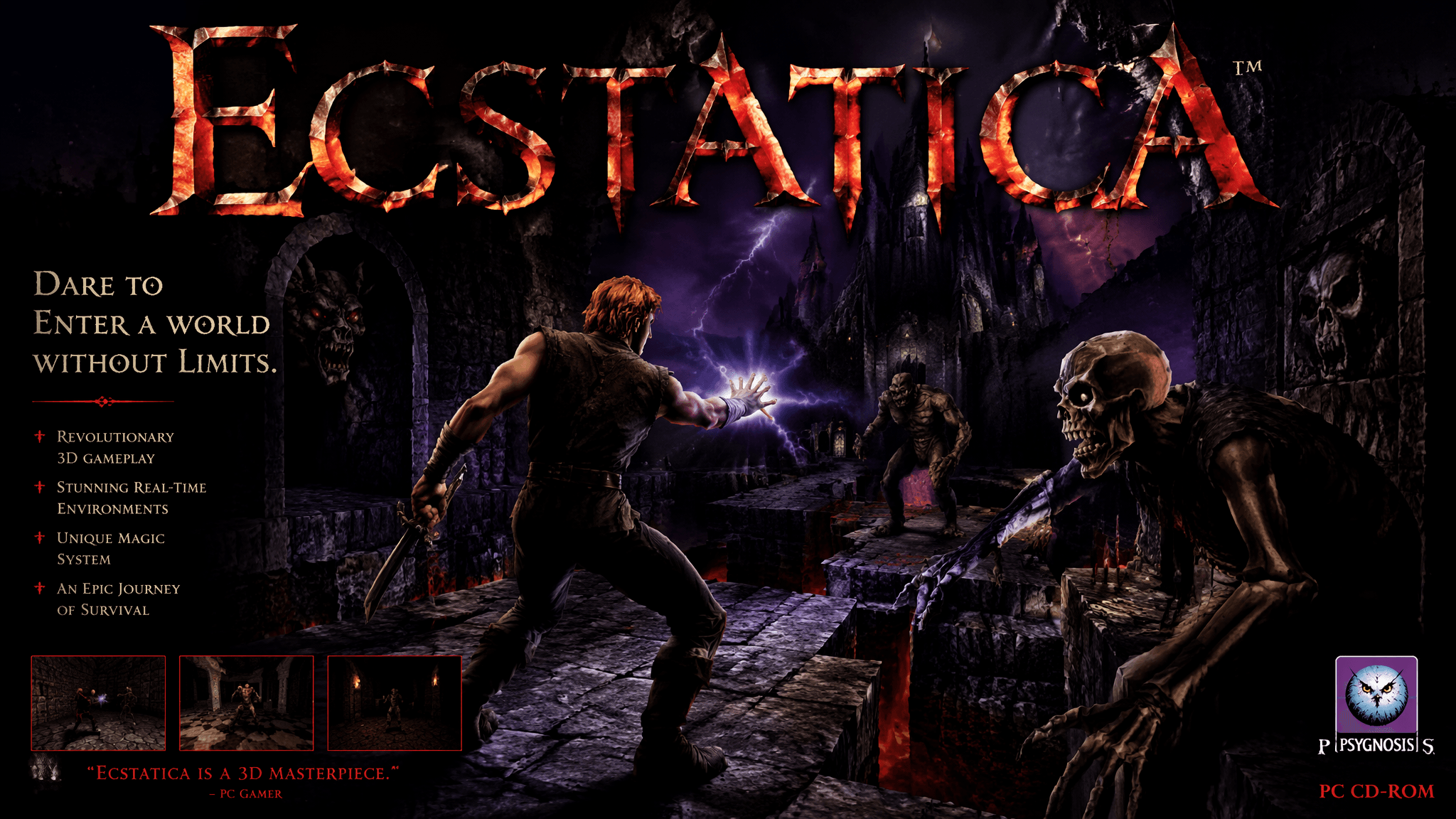
If you so much as flipped through a PC gaming magazine back in the mid-'90s, there's a good chance the name Ecstatica rings a bell. Created by London-based developer Andrew Spencer and published by Psygnosis, the cult series spanned two entries. The original launched in 1994 as a medieval survival horror title, while the sequel arrived in 1997 — still unmistakably an Ecstatica game thanks to its signature visual style, but with the horror elements toned down considerably.
That art style is what makes the series truly unforgettable. Rather than building characters out of standard polygons, Ecstatica's custom engine used ellipsoids — essentially, rounded, bulbous shapes. Rather than walk you through the dry Wikipedia definition of an ellipsoid, it's easier to just see it in action:
It's an instantly recognizable look, and famously, Andrew Spencer built the entire engine himself from the ground up. Those ellipsoids aren't just a visual trick, either. Other games with a similarly soft aesthetic, like Little Big Adventure, rely on Gouraud shading to smooth out the look of sharp, angular geometry underneath.
As Spencer explained to Next Generation magazine back in 1996: "The main advantage is the organic-looking characters. Triangles tend to make hard, robotic-looking figures, whereas ellipsoids can be used to create more rounded, human alternatives. Ellipsoids can also be more efficient because you can make a much better looking character out of fewer shapes."
From a 2026 perspective, I doubt many people would look at Ecstatica's cast and call them "organic-looking." But I vividly remember being stunned by how the games looked in static magazine screenshots back in the day. Next to contemporaries like Alone in the Dark, it genuinely felt like a visual leap forward — even if, in practice, it was more of a lateral creative choice than a straight upgrade.