
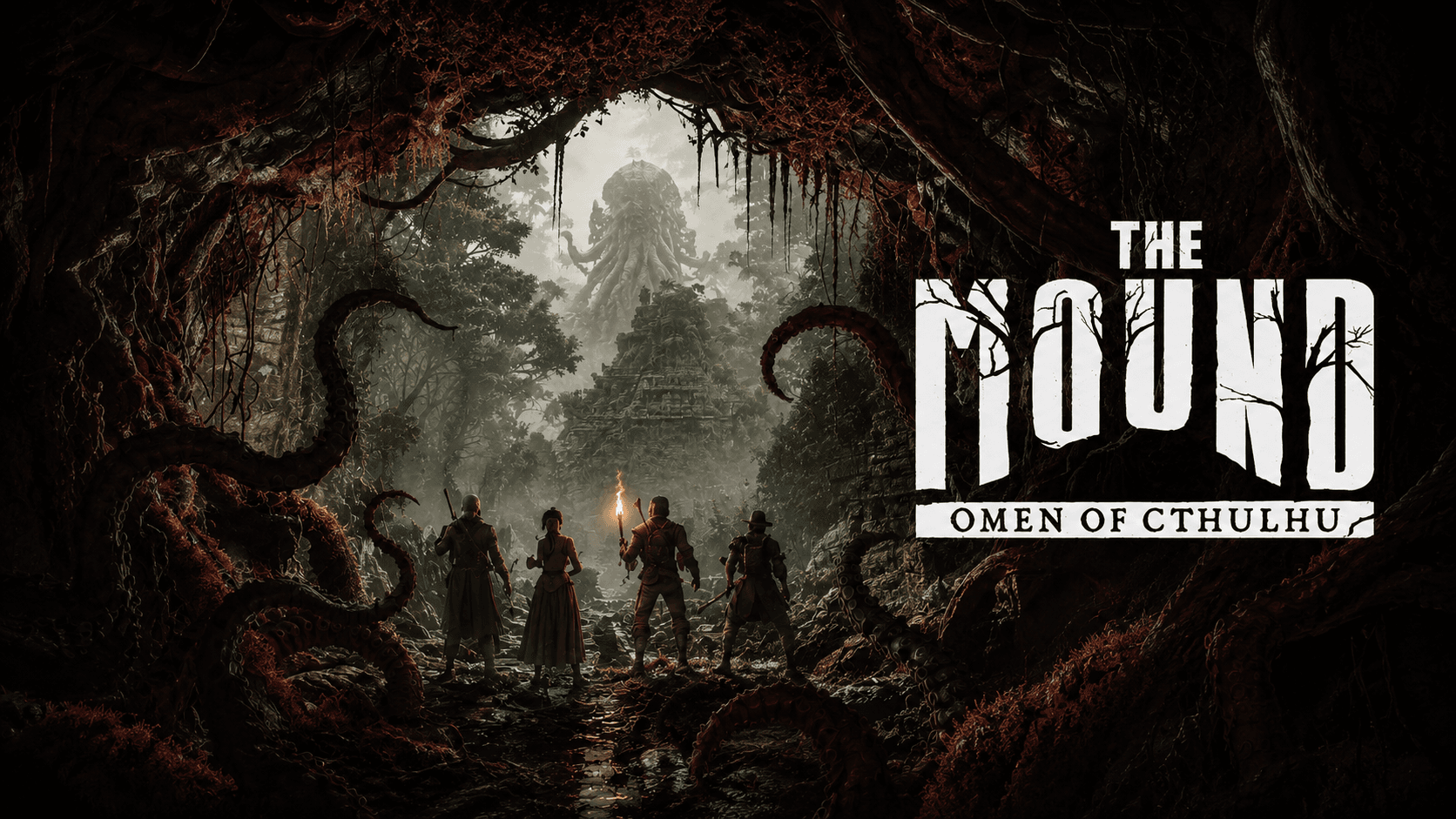
There’s one moment that perfectly sums up the core identity of co-op survival horror title The Mound: Omen of Cthulhu: I was yelling at my friend over voice chat, repeatedly asking what he found so funny, right before I was violently killed.
As it turned out, that wasn’t my friend at all. It was a Faceless One mimicking his character model, looping a recording of his laughter from earlier in the match.
When it comes to making players question their own sanity, The Mound’s inventive madness mechanics are genuinely inspired. All too often, though, those clever ideas take a backseat to unforgiving difficulty that doesn’t always respect your time — and makes bringing new players into the fold far harder than it should be.
Setting & Narrative: Cthulhu Meets 17th-Century Chile
It took over 50 expeditions and roughly 50 hours of exploring the stunning Chilean wilderness to uncover every secret buried in The Mound’s rich mid-17th century setting. You and your friends step into the boots of conquistadors, ignoring every red flag and warning of danger to plunder riches for the Spanish crown — all while evading the restless dead and desecrating the crypts of unknowable alien deities.
When it comes to nailing the atmosphere of the Cthulhu mythos, developer ACE Team has knocked it out of the park.
Colonial Storytelling: A Mostly Solid Handling
Naturally, when “Lovecraft” and “conquistadors” appear in the same pitch, there’s immediate potential for deeply uncomfortable colonial baggage — a particular brand of ugly historical baggage that modern Lovecraft adaptations have increasingly had to navigate.
For the most part, Omen of Cthulhu handles this tightrope walk about as well as many of those recent, more thoughtful adaptations. The Mapuche people, indigenous to this region of Chile, are referenced multiple times throughout the story, and the game is careful never to conflate them with the deranged Elder God cultists lurking deeper in the jungle.
I would have welcomed more representation and depth where the Mapuche are concerned, and the game still leans into the familiar trope of the New World as a savage, untamed wilderness teeming with nightmares and dark magic — a staple of colonial storytelling. Even so, it’s a marked improvement over how Lovecraft himself would have framed the story.
The narrative of The Mound and the horrors hidden beneath it unfold through well-written journal entries paired with strong voice acting. I thoroughly enjoyed piecing together the mystery bit by bit, and the late-game revelations land with genuine dramatic weight.
Core Loop: Contracts & Loadout Strategy
Spread across 18 intricately designed maps that connect to form one large, cohesive world — though you can only access one region per expedition — you take on contracts, each with a set objective, a reward payout, and a pre-determined pool of gear scaled to your party size (up to a maximum of four players).
I really like this approach to loadouts. More often than not, there aren’t enough weapons to go around, so your group has to make deliberate choices: who handles combat, who carries the lantern to light dark passages, who travels light with empty inventory slots to maximize loot capacity. It also pushes you to experiment with different equipment instead of falling into the habit of bringing the same loadout every single run.
The Biggest Flaw: Difficulty Design That Fights The Player
That said, I hit a snag with the contract system around the 20-hour mark: the pool of available missions appears to scale with the server host’s character level.
That meant when I wanted to bring a brand-new friend into the game, there were barely any Basic or even Medium-difficulty contracts left to help them learn the ropes. I appreciate how in similar co-op horror games like Phasmophobia, you can grind beginner missions for resources as much as you want and freely pick difficulty levels that work for whoever you’re playing with. It’s a notable shortcoming here, especially since The Mound can be brutally punishing even on Basic expeditions.
Base Difficulty Is Simply Too High
And my regular group is far from inexperienced — we’ve put hundreds of hours into co-op games like Phasmophobia, Lethal Company, Abiotic Factor, and Valheim together. We’re no rookies. Even so, we all arrived at the same conclusion pretty quickly: put simply, The Mound is really, really hard.
Some of that difficulty softens once you learn how certain mechanics work. For instance, we discovered that the timer running on most expeditions barely matters at all, and what actually matters is moving quietly to avoid riling up the forest’s more dangerous inhabitants. But even when we felt we were playing optimally, the sheer number and lethality of enemies would sometimes ramp up so fast that the challenge crossed from tough to overwhelming. When it’s four of us against a dozen zombies with nowhere to sneak around, even on the lowest difficulty, what exactly are you supposed to do? And that’s assuming you even have Basic contracts available to attempt in the first place.
Portal Missions: The Low Point
The absolute worst offenders are portal missions. These strip you of your usual ox cart for carrying loot and drop you into a modified version of the map blanketed in purple goop that kills you almost instantly if you so much as step in it for what feels like three seconds — which also means your teammates can’t get close enough to revive you.
I don’t think I ever had a genuinely fun run on one of these missions, and eventually I started skipping them whenever possible. After seven or eight failed expeditions in a row, we kept asking ourselves if this was really the intended experience or if we were missing some key mechanic that would make it feel fair — and the answer seems to be that yes, this is how it’s supposed to be.
A Note On The Difficulty Patch
The issue isn’t really that Advanced and Legendary missions are brutally hard. They should be! I want endgame content to work toward. The problem is that there aren’t enough options to tune the difficulty to match your group or your mood. The baseline is just too high.
I should note that a fairly major patch dropped about a day before this review went live, which adjusted difficulty among other things, but it arrived so late that I haven’t been able to test it extensively. From the couple of expeditions I’ve run since, it doesn’t seem to have dramatically shifted the overall feel.
What Works: Fantastic Enemy Design & Tense Horror Loops
There is some meta-progression between contracts to take the edge off, but most character levels only unlock new knife skins that are purely cosmetic. Being able to buy or upgrade gear before a tough run is a nice feature, but since you lose all those extra items and upgrades when you die, it’s all too easy to fail an Advanced or Legendary contract a few times in a row, end up completely broke, and have no easy way to grind for quick cash on easier missions to rebuild before trying again.
It’s a real shame, because when The Mound isn’t being relentlessly brutal, its tense combat and horror mechanics click together beautifully.
The enemy variety is genuinely impressive, drawing from the deepest corners of the Cthulhu mythos. You’ll face everything from basic, unsettling possessed humans all the way up to bizarre, reality-warping abominations that may not even be killable — forcing your party to navigate around them using specific, clever strategies.
Resource management feels meaningful, and the uncertain value of treasure creates genuinely thrilling moments where you’re never quite sure if you’ve looted enough to hit your quota, but you can feel the jungle growing more hostile by the minute.
Solo Play Is Not Recommended
It’s also hard to recommend The Mound as a solo experience. The game does spawn an NPC companion to help you out, but they’re nowhere near as capable as a human player, and trying to complete contracts alone can feel like an uphill battle even with reduced enemy counts.
“A co-op game is better with friends” is hardly a groundbreaking observation, but since solo play is offered as an option, it’s worth calling out that it’s not where the game shines.