
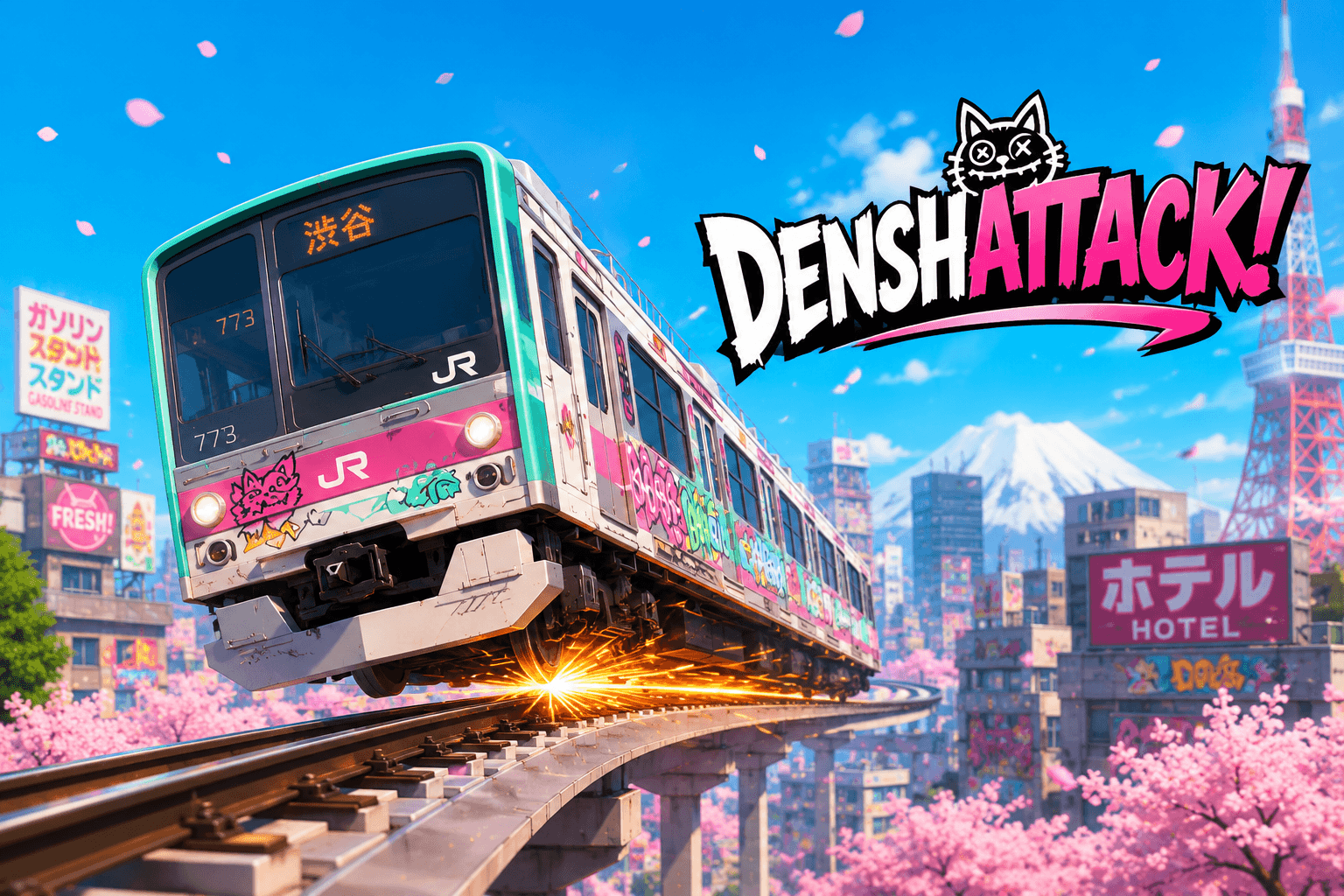
Every so often, a game lands that feels like it was custom-built for every single thing you love. Denshattack is exactly that.
It’s the kind of experience that felt everywhere back in the PS2 era — the sort of wildly creative, unpretentious fun that mostly lives on in the indie scene these days. Modern big-budget games chase prestige and seamless polish, leaving no room for silly, unapologetic chaos. Denshattack is unapologetically silly, and that’s the highest compliment I can give it.
The Elevator Pitch
Imagine Tony Hawk’s Pro Skater and Jet Set Radio doing a Dragon Ball-style fusion dance — except instead of a skateboard, you’re piloting a train tearing through a dystopian Japan, pulling absurd stunts and flipping off an evil corporate overlord.
Sounds impossibly cool, right? Spoiler: it delivers. Two thoughts looped in my head the entire playthrough: “This is so sick,” and “There is zero reason this works as well as it does. How did they pull this off?”
Story & Cast: Straight Out Of A 2000s Anime
Denshattack’s charming story feels lifted directly from a classic anime series, which pairs perfectly with its bright, anime-inspired art direction.
You play as Emi, a young woman making a living delivering ramen by train across a future Japan ravaged by climate change. Most of the population — anyone wealthy enough to afford it, anyway — lives inside shielded domed cities run by Miraido, a sinister megacorporation (is there any other kind?). The same company also controls the high-speed VACTRAIN lines linking the domes. Classic monopoly energy.
Life is harder for folks outside the domes, but at least they don’t answer to Miraido. Emi is one of those outsiders, and she soon crosses paths with Fernando, a fellow rebel who runs a zine about an underground subculture called Denshattack: a renegade sport where Japan’s boldest train pilots compete via stunt runs and races. Emi dives headfirst into the scene, set on becoming the greatest Denshattack rider of all time, with Fernando along for the ride documenting every second.
Familiar Archetypes, Done Right
Emi is basically Goku but with a train: relentlessly upbeat, instantly endearing, and a natural prodigy always chasing self-improvement. Her climb to the top brings her face to face with gangs scattered across Japan, each led by a charismatic boss. Beat a gang leader, and they’re usually so impressed by her skills they end up joining her crew.
The character tropes are all comfortingly familiar: the bubbly, fashion-obsessed rich girl who’s always in your corner; the aloof rival who signs on because she’s curious where this goes (definitely not because she respects you, don’t be weird); the veteran rockabilly engineers who come out of semi-retirement when they meet someone talented enough to do their creations justice.
None of it breaks new ground — and that’s not a flaw. Denshattack plays all the greatest hits, and they still slap. Its scrappy punk-rock attitude is genuinely contagious, too.
Core Gameplay: Tricks, Trains, And Flow
At the end of the day, the story is just a fun excuse to get you behind the controls of a train that can pull ollies and kickflips.
Denshattack’s version of Japan is split into interconnected rail networks, and your train is built to handle every wild twist they throw at you. You can launch into the air, flip across to adjacent tracks, catch massive air off ramps, and pull off way more.
The Trick System
Chaining tricks together is the core loop, and the game smartly maps the whole system to the right analog stick. Flick left for a basic ollie; pull a half-circle for something like a 540 heelflip. More elaborate stunts need more complex inputs — and for the truly showstopping moves (there are dozens to master), you’ll be pulling fighting game-style command inputs.
There’s a catch, though: spam the same move too many times in a row, and it loses style points. Flair is everything, and racking up high scores means building a diverse trick vocabulary.
It takes time to get comfortable pulling specific moves on command, but the game includes the brilliantly named, incredibly useful Tricktionary — accessible any time you need a refresher. When I first started, I could barely nail basic stunts. Now I’m landing Impossible Cancels like second nature. The trick system has surprising depth, and unlocking new moves to add to your arsenal as you progress is endlessly satisfying.
Level Design: No Two Runs Feel The Same
The real secret sauce, though, is the level design itself. The 10–15 hour campaign takes you all across Japan, and you’ll run into some genuinely wild set pieces along the way. You’ll grind over ancient stone heads, loop around a Ferris wheel in an abandoned city, and topple Miraido cell towers as you speed past. And those are the tame parts. I’ve ridden rails through an active volcano, gotten swallowed whole by a giant shark, and pulled stunts mid-kabuki performance.
What makes Denshattack shine is how much variety is packed into every track. Some courses are straightforward speed runs. Others pit you against rival riders (who you can absolutely knock off the rails), challenge you to set a high score, or task you with completing objectives scattered across branching track paths. One level had me clearing a collapsed bridge, restoring a piece of “rebellious” street art Miraido censored, and dropping off a soba delivery — I could pick which track branch to take, and tackling each objective was entirely up to me.
Hidden Paths: The 8 Million Roads
Every level has multiple branching paths that can unlock entirely new exits. Play with enough style, and you can chain tricks to fill your energy gauge to unlock the Yaoyorozuo — the “8 Million Roads” — alternate, soaring, elaborate rainbow-colored tracks that lead to hidden areas. Think of it like if Mario Kart’s Rainbow Road was a secret bonus path you could unlock on every single track, and you’ve got the right idea.
Feel & Flow: Pure Chaotic Joy
There’s a lot to juggle, and the pure joy of Denshattack comes from weaving everything together — drifting, jumping, pulling tricks, rail grinding, wall riding, looping through tunnels, holding manuals, honking your horn to trigger environmental interactions, and so much more — all without wiping out or derailing.
Clean runs aren’t always easy, but checkpoints are forgiving, and your crew always has words of encouragement when you mess up. You’ll fail constantly, but it never ends your run — it just costs you a little time.
What’s really impressive is how the game keeps raising the stakes the whole way through. Just when you think you’ve seen every trick it has up its sleeve, it throws something new at you: “Oh, by the way, now you can latch onto monorail tracks,” or “Hey, wanna ride these updraft air currents?” It’s endlessly cool.
It also doesn’t hurt that every level is backed by some of the smoothest, most infectious soundtrack bops I’ve heard in a game in ages.
Replay Value & Customization
Individual missions are usually pretty short, but there’s massive replay value and room for mastery, plus tons of collectibles to hunt down: parts to unlock new trains, spray cans and stickers to customize your ride to match your personal aesthetic.
My favorite touch is the photo opportunities you can nail for Fernando, which then get featured in the latest issue of his zine. The zines themselves are surprisingly detailed, packed with regional lore, character profiles, train specs, story recaps, and even Emi’s ramen reviews. It’s such a delightful, thoughtful touch.
Challenges & Score Chasing
Every level also includes optional dare challenges: things like completing the course without a single crash, derailing a set number of rival riders, finding a hidden exit, pulling a specific trick at a specific spot, and more. They’re all a blast, and they gave me every reason to go back and replay levels to see what I’d missed.
On top of that, you’re graded on both time and trick score — so if score-chasing is your thing (it definitely is mine), there’s plenty to sink your teeth into. I mostly walked away with bronze and silver medals on my first playthrough, and I’m already looking forward to going back to chase faster times and higher scores.
Train Builds
Between missions, you can spend your collected resources on new trains, each with their own strengths and tradeoffs. I grew particularly fond of one build that boosted my trick execution speed but shortened my manual distance, and another that filled my energy bar faster at the cost of lower individual trick scores — which overall meant I could access the 8 Million Roads way sooner. It’s all so satisfying. Certain levels reward picking specific trains if you’re going for top scores, but the choice is always yours, and the customization gives you even more incentive to revisit older stages and grab any collectibles you missed.
The Showstoppers: Boss Fights That Actually Slap
But Denshattack’s real standouts are the boss fights that cap off each region. Wanna go head-to-head with a fleet of trains that combine Voltron-style into a Megazord? You got it. How about a showdown with a train that’s also a giant sand serpent you can grind along? It’s in there. More of a fan of a moving fortress armed with a colossal cannon? Say less.
Denshattack leans fully into its most over-the-top anime energy during these sequences, and every single one feels distinct while still building naturally on the mechanics you’ve mastered in the regular stages. Boss fights in this genre usually end up feeling like afterthoughts, but Denshattack’s are as smooth and satisfying as a high-speed train catching massive air, nailing a perfect trick, and landing flawlessly on the next track. You don’t go in expecting them to be this good, but you’ll be thrilled that they are.